
The Subtle Art of Clinical Pattern Recognition
You can learn a lot about a patient before you ever touch their chart. From the moment a nurse walks into a room, the assessment has already begun. Everything within that room is a clue: how the patient is sitting, how the air feels, the particular sound of their breathing, even the energy in the space.
Our fives senses are used every day to determine what could be happening to our patients. They help us know when to watch someone more closely — even when the patient insist they feel fine. Clinical intuition is a finely tuned ability that begins the moment we call ourselves nurses.
I. The First Five Seconds
My first interaction with a patient seems very informal. I introduce myself, greet the patient and their visitors, let them know I’ll be their nurse, and ask them how they’re doing or if they needed anything.
All of that is important —but there is more happening beneath the surface.
Mental Status
When I meet a patient and begin asking them questions, I’m already judging their mental status.
Are they making eye contact?
Are their answers appropriate and timely?
Do they seem confused by my presence or what I’m asking?
Breathing
Before I ever pull out my stethoscope, I’m listening.
Are they winded after a single sentence?
Are they wheezing?
Is their breathing fast?
Are they struggling to catch their breath?
Posture + Expressions
I study their posture and facial expressions.
Are they guarding a certain part of their body?
Are they smiling, grimacing, flushed, sweating, withdrawn?
A flushed face could simply mean someone is warm…or it could be the start of an infection.
Smell
As strange as it sounds, smell plays a major role in an assessment.
I once cared for an elderly patient who appeared calm and comfortable, watching TV. But as I approached her bed, I caught the strong copper scent of blood. When I lifted her sheet, her bedding was soaked. She had been bleeding for some time — but was too embarrassed to say anything.
The Room
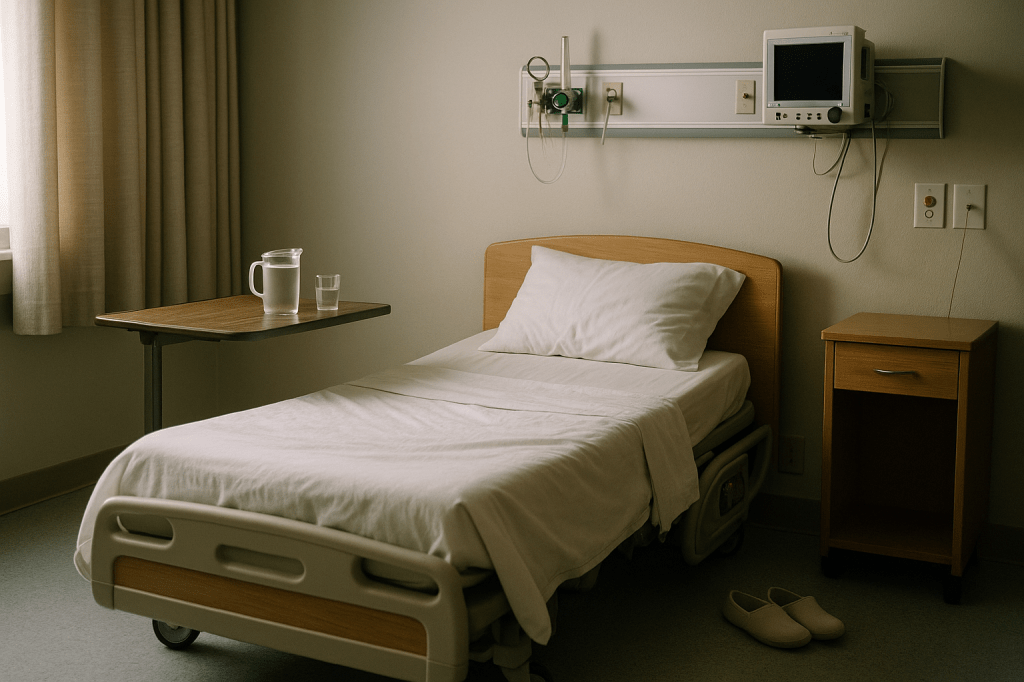
I’m scanning the environment the entire time:
Is the oxygen connected?
Is the bed low to the ground or is it raised dangerously high?
Are the side rails up?
Is emergency equipment in the room should I need it?
All of these things can be noticed by a trained nurse in the first five seconds of entering a patient’s room.
II. The Patient’s Nonverbal Story
Listening to what patients say is essential — but hearing what they don’t say is just as important.
Delayed answers may mean confusion, fear, or withholding. Avoiding eye contact might indicate embarrassment, pain, or impending loss of consciousness. A sudden flat affect tells us something might be wrong.
I’ve had patients answer questions while constantly looking at a family member for permission. Their shoulders were hunched, their eyes down, and their voice quiet. Those cues alone told me something wasn’t right.
III. The Room’s Story (Environmental Clues)
It’s often the smallest details— the ones most people overlook —that give us the most information about a patient and their condition.
There was a diabetic patient who had been on the unit for several days. He took his medications and ate the meals we provided him without complaint, yet his blood sugars remained dangerously high. No matter how many adjustments the doctor made, we couldn’t get his levels under control. It wasn’t until I looked in the bathroom trashcan that I found the reason: hidden chocolate wrappers and fast food containers he’s been sneaking between checks. A tiny detail, but it changed the entire plan of care.
Small changes to a room can tell a story too. I once cared for a patient recovering from a his knee replacement who felt wonderful after physical therapy— a little too wonderful. He knew he needed help to get out of bed safely, but when I walked in, I noticed his walker wasn’t where I placed it. Instead of tucked neatly against the wall, it had been pulled forward and angled. A small shift in the room, but a big clue: he tried to get up alone.
Environmental clues rarely shout.
They whisper.
And if you know how to listen, they reveal exactly what the patient isn’t saying.
IV. Reading What Isn’t Written
What nursing has taught me is that patients begin speaking to us long before they say a word.
A posture, a breath, a glance toward a family member — every gesture carries meaning.
Even a room, untouched by chart notes, can reveal a story waiting quietly in the margins.
Most people rush past these details. But nurses learn to pause, to look twice, to let the smallest clue guide us toward what a patient needs most.
This isn’t instinct.
It’s attention — shaped by experience, sharpened by compassion, and strengthened every time we choose to slow down and see.
Before the labs, before the chart, before the care plan, there is a human being asking to be understood.
And that is the art behind the science of nursing:
to read what isn’t written,
to hear what isn’t spoken,
and to translate the unseen into care that heals.
 Clarity and Case
Leave a comment