
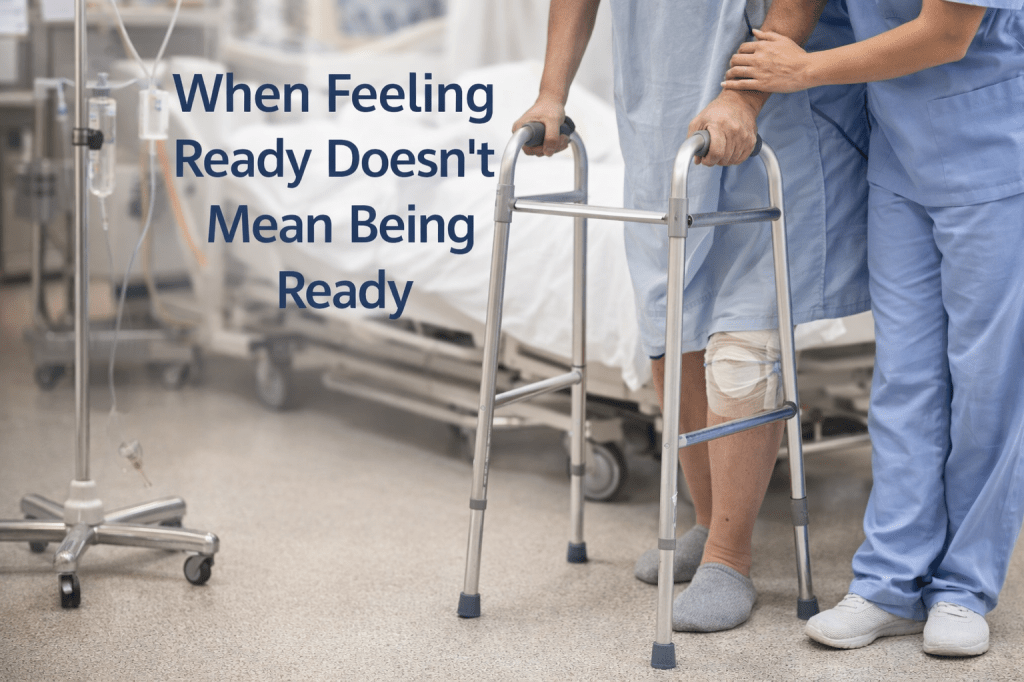
I. When Patients Want to Do It Themselves
Being faced with a hospital stay can be frightening. Not only are you dealing with a medical situation you’re not equipped to manage on your own, but you’re also suddenly surrounded by strangers. Strangers who manage your care and who can seem to control many aspects of your day-to-day life.
It can feel like you’re losing control of your own body and your own routine. That frustration is understandable, even when what we’re saying makes logical sense.
Encouraging independence and autonomy is one of the goals of a hospital stay, especially as we prepare you to return home. But before we can focus on independence, our first responsibility is safety.
Even if you’re fully independent at home, your body is navigating new territory in the hospital. New medications. New procedures. New limitations. All of these can temporary affect your balance, strength, judgement, and coordination — often in ways you can’t feel right away.
Wanting to do things yourself isn’t a sign of stubbornness or resistance. It’s a natural response to feeling vulnerable. The challenge is that in the hospital what feels familiar isn’t always what’s safe — at least not yet.
II. Why Nurses Sometimes Say “No” Anyway
When a patient has to have scheduled—or even emergency —surgery, its natural to want to return to normal as quickly as possible. To go home. To move the way you did before. To resume the routines that feel familiar and safe.
But after surgery, there are factors at play that aren’t always obvious.
Even when you’re awake, alert, and able to communicate, medications are still working in your body. Anesthesia doesn’t disappear the moment you open your eyes. It lingers, sometimes for hours, and can slow reaction time, affect balance, and can cause weakness or dizziness.
When pain medication is added on top of that, those effects can intensify.
This is where a false sense of readiness can develop.
Feeling better does not always mean your body is ready. Wanting to do something— standing up, walking independently, going to the bathroom alone — is not the same as being safe to do it yet.
When nurses say “no,”it’s rarely about limiting independence. It’s about timing. About recognizing that your body may still be catching up to how capable you feel in the moment.
Saying “not yet” is often how we prevent a situation from becoming an emergency.
III. When Doing It Yourself Becomes Risky
When a patient chooses to ignore the guidance of the medical team, they can unknowingly place themselves at risk. Many patients feel a strong desire to prove that they can get up and move on their own —that they don’t need help.
But in the hospital, we don’t wait for proof when the stakes involve safety. Waiting to “see what happens” increases the chance of harm.
By the time we ask you not to get out of bed alone, risk assessment has already begun. We’re considering the medication in your system, how recently you had surgery, your strength, your balance, and your ability to follow instructions — often before you even attempt to stand.
All of those factors guide how we move forward and how we keep you safe.
The type of surgery you’ve had also plays a role. Instructions can change depending on what your body is healing from. After orthopedic surgeries— such as knee, hip or shoulder replacements— we may require a walker or assistance to provide stability. Not because you’re incapable, but because your body is temporarily vulnerable.
In other cases, surgical drains, IV lines, or monitoring equipment may be present. These can quickly become tripping hazards or be accidentally dislodged if you try to move them without help.
From a nursing perspective, these are not restrictions — they are safeguards. They exist to prevent a recoverable situation from becoming an avoidable emergency.
IV. The Story
A patient of mine had just undergone their first knee replacement. In the hours after surgery, they were feeling good — with minimal pain and little discomfort. When I received report, they had been out of surgery for about two hours.
During that time, the patient had already walked down the hall with a walker and a nurse beside them without any issues.
They were grateful for the procedure and hopeful about what came next. They understood that being able to go home would depend on doing well in physical therapy, which was scheduled for the following day.
Because their pain was minimal and their earlier walk had gone well, the patient decided that they wanted to walk to the bathroom on their own. They believed they were ready. They wanted to prove — to themselves— that they could do it.
They managed to get out of bed and take a few steps, without a walker, toward the bathroom before they fell on to their newly replaced knee.
The fall caused damage to the surgical site and the patient ultimately had to return to the operating room to repair it.
It was an unfortunate and avoidable incident. The patient wasn’t acting recklessly —they acted out of a desire for independence. They wanted autonomy. They wanted to complete a simple, everyday task without help.
And that desire is deeply human.
But in that moment, their body was not ready — even though it felt like it was.
V. Independence Comes Back — When the Body Is Ready
Independence doesn’t disappear during a hospital stay — it’s temporarily protected. In the early stages of recovery, especially after surgery or the introduction of new medications, the body may not yet match how capable or motivated a person feels. That mismatch is where risk lives.
Accepting help in those moments isn’t a set back. It’s a way of preventing delays, complications, or injuries that can extend recovery far beyond what was expected.
Even when we are telling you “no” or asking you to call for assistance before getting up, understand that those limits are temporary. Safety decisions are constantly reassessed as your condition improves and your body regains strength.
Trusting the guidance given in the hospital helps protect long-term outcomes. We teach you how to move safely, how to get up properly, and how to rebuild confidence — not to limit your independence, but to preserve it for when you return home.
The goal is never to keep patients dependent.
It’s to make sure independence returns without injury.
Independence isn’t proven by doing everything alone. It’s built by knowing when support is needed— and trusting it long enough for the body to catch up.
VI. Conclusion
Wanting to do things on your own doesn’t make you difficult. It makes you human.
Hospitals are unfamiliar places, and losing temporary independence can feel frustrating — even humiliating at times. But when nurses step in, slow things down, or say “not yet,” it isn’t about control. It’s about protecting you during a moment when your body hasn’t fully caught up with how capable you feel.
Independence isn’t taken away in the hospital — it’s safeguarded. Every precaution, every pause, and every request to call for help is meant to prevent a setback that could delay healing or cause harm.
The goal is always the same:
to help you recover fully, return home safely, and regain independence without injury.
And when your body is ready — we step back.
 Clarity and Case
Leave a comment