
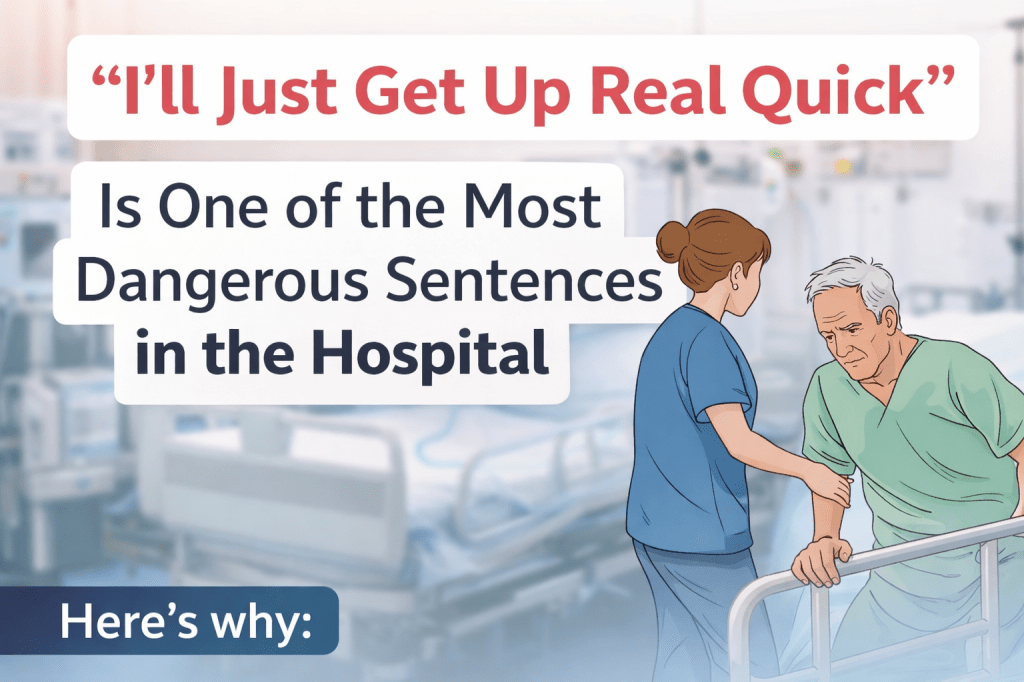
I. The Moment Nurses Hear It
A rarely spoken goal in the hospital is to encourage patients to be independent. One day, every patient will be discharged from our care, and it’s important that they are able to take care of themselves. To support that, nurses intentionally create opportunities for patients to do things on their own—from feeding themselves to participating in physical therapy exercises.
The key is not independence itself, but safe independence.
So when a nurse hears a patient say:
“I’ll just get up real quick.”
It creates an immediate pause.
To the patient, it’s a harmless sentence— something they say and do everyday without thinking. But to a nurse, it signals risk. It means there is a real possibility of dizziness, imbalance, or falling, and with that, the potential for injury that could undo recovery in seconds.
What sounds like a small, casual decision to a patient often triggers a much larger safety assessment for the nurse.
II. Why “Real Quick” Isn’t Quick in the Hospital
When a patient says, “I’ll just get up real quick,” what we hear isn’t urgency — it’s uncertainty.
In the hospital, standing up is never just standing up. It’s a full-body transition that happens in a body that may still be recovering from surgery, adjusting to new medications, or responding to pain in ways that aren’t always obvious yet.
Before a nurse encourages a patient to get up on their own, several factors are already being considered: blood pressure trends, pain control, recent medications, muscle strength, balance, and how the patient tolerated their last movement. Even something as simple as dizziness can take a few seconds to appear — often after the patient has already stood.
Medications that help with pain, nausea, or anxiety can slow reaction time and affect coordination. Anesthesia and sedatives can linger in the body far longer than patients realize. What feels stable in bed can change quickly once gravity is involved.
Nurses also know that falls don’t usually happen during the “big” movements — they happen in the in-between moments. The pivot. The first step. The shift of weight that feels familiar at home but behaves very differently in a hospital room.
So when we ask you to wait, to call first, or to let us help, it isn’t about limiting independence. It’s about preventing a moment that can turn a short hospital stay into a much longer recovery.
III. What Can Happen When the Body Isn’t Ready
After surgery or illness, the body can behave unpredictably — even when a patient feels confident and alert. Changes in blood pressure, balance, and muscle strength often don’t show themselves until movement begins.
One of the most common risks is a sudden drop in blood pressure when standing. A patient may feel steady at first, only to become lightheaded seconds later. Weakness can appear mid-step. Coordination can falter just enough to throw balance off.
Medications play a role as well. Pain medication, sedatives, and anesthesia can linger in the body, slowing reaction time and dulling the ability to correct a misstep. What feels like a normal movement at home can behave very differently in a hospital room.
This is why falls so often happen during the transition — not while lying in bed, and not always immediately upon standing, but in the brief moments in between. The body hasn’t caught up to the intention yet.
When someone says, “I’ll just get up real quick,” the danger isn’t the movement itself. It’s that the body may not be ready to support it — and the consequences can unfold before there’s time to react.
While nurses are quietly assessing trends and risk, the body is doing something else entirely — reacting in real time.
IV. The Story
A kind, older patient on my unit lay in bed several hours after a minor surgical procedure, watching as medical staff moved quickly from one room to the next. They had children in the medical field and understood some of the weight and responsibility carried by the healthcare workers.
Wanting not to be a burden, the patient decided they felt well enough to go to the bathroom on their own.
They lowered the side rail and stood up for the first time since surgery— unassisted. Within seconds, the patient became dizzy. Moments later, they were found unconscious on the floor, bleeding from a head wound.
Because the patient lost consciousness, struck their head, and was taking blood thinners the situation immediately became a medical emergency. The patient was transferred to the intensive care unit with a brain bleed.
What felt like a small, reasonable decision became a life-threatening event in minutes.
V. The Lesson
What made this situation especially difficult was that the patient didn’t act out of recklessness or defiance. They acted out of consideration. They didn’t want to interrupt busy staff. They didn’t want to be a burden. They believed they were helping.
From the patient’s perspective, getting up “real quick” felt reasonable — even polite.
From a nursing perspective, that same moment carried hidden risks the patient couldn’t feel or see yet: changes in blood pressure, lingering anesthesia effects, delayed dizziness, and medications that increase the danger of even a minor fall.
This is where the disconnect often lives.
When nurses ask patients to wait, to call first, or to accept help, it isn’t about limiting independence. It’s about timing. Independence doesn’t disappear in the hospital — it’s temporarily protected until the body can safely support it again.
What patients often experience as over-caution is, in reality, a nurse trying to prevent a moment that can’t be undone.
VI. The Takeaway
Nurses want patients to regain their independence. It’s the goal of recovery. But independence returns safely only when the body is ready — not when it feels ready.
When a nurse asks you to wait, to call, or to let us help, it isn’t because we doubt your ability. It’s because we’re watching for the risks you can’t feel yet.
The sentence “I’ll just get up real quick” sounds harmless — until it isn’t.
And our job is to make sure you get home safely, not quickly.
 Clarity and Case
Leave a comment