
There are moments in healthcare when everything looks right on paper.
Vitals are charted. Orders are in. The room feels calm. The patient looks stable. And because everything appears accounted for, we move on—confident that the basics have already been done.
But sometimes, the most important thing hasn’t been confirmed at all.
A pulse is one of the simplest assessments we learn. It’s taught early, practiced often, and eventually assumed. We stop respecting it because it feels too basic, too obvious to miss. Yet the truth is uncomfortable: the more familiar an assessment becomes, the easier it is to skip—not out of negligence, but out of habit.
Vitals Documented vs Assessment Performed
A documented vital sign is not the same thing as an assessment performed. Numbers tell part of the story. Touch tells you whether the story is true.
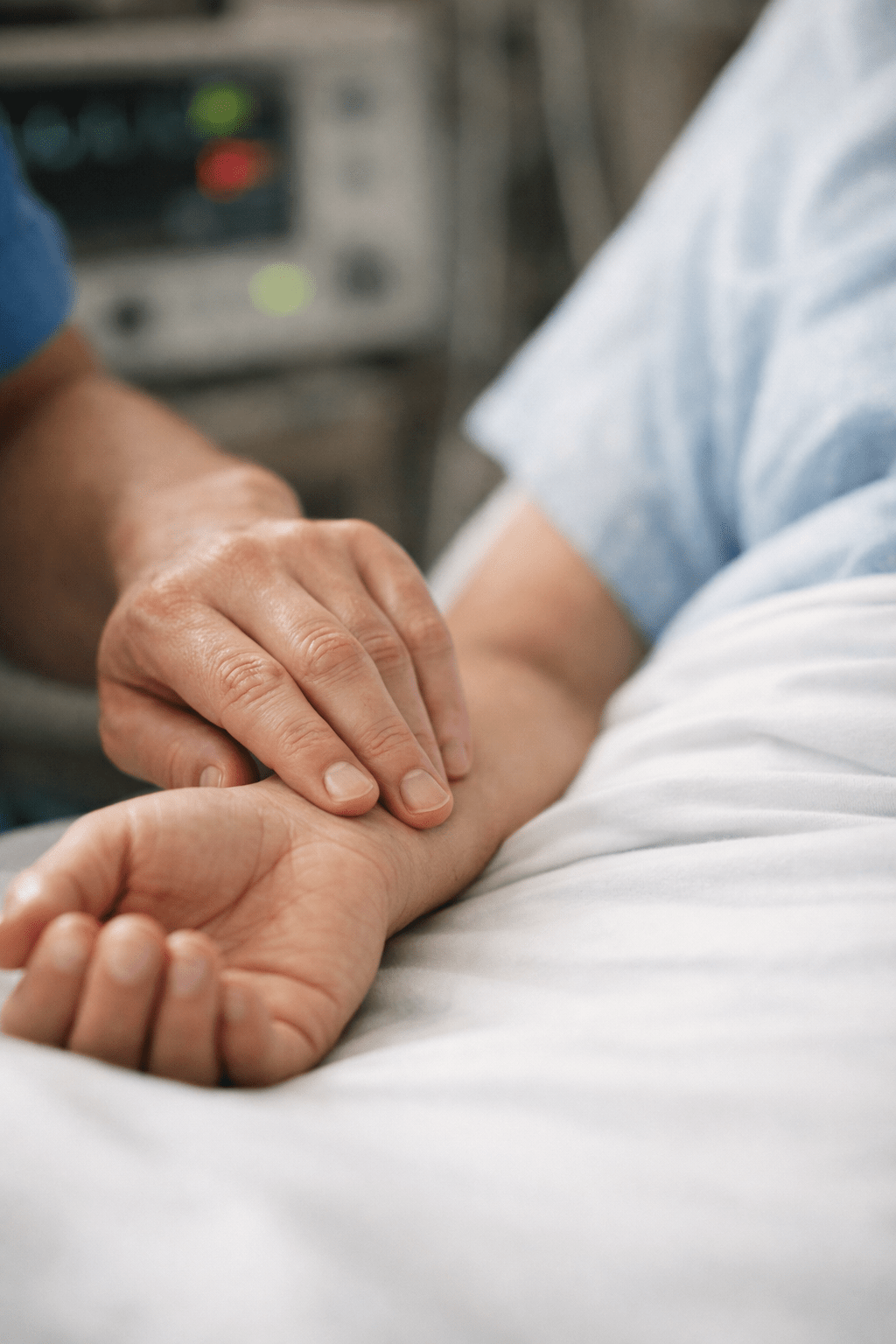
When you take a pulse with your hands, you’re not just checking for a rate. You’re confirming presence. You’re assessing strength, regularity, rhythm, and response. You’re verifying that what the chart suggests aligns with what the body is doing in real time.
A pulse felt is not passive—it requires intention.
And intention is often what gets lost when systems move faster than people.
When Basics Become Optional
In busy environments, assessments are divided, delegated, and inherited. Someone else must have checked. The monitor is on. The vitals are recent. The assumption quietly settles in that confirmation has already happened.
But assumptions are not assessments. They are placeholders for certainty we haven’t earned.
What’s dangerous isn’t that the pulse check is forgotten—it’s that it’s dismissed as unnecessary. As if fundamentals are beneath advanced practice. As if experience replaces verification. As if confidence can stand in for confirmation.
This is how basics disappear.
Not because clinicians don’t care, but because familiarity breeds shortcuts. Time pressure rewards efficiency over thoroughness. Charting competes with presence. And slowly, almost invisibly, the line between “done” and “assumed done” blurs.
The Quiet Work of Competence
Competence has never been about complexity. It has always been about consistency.
The most reliable clinicians are rarely the loudest or the flashiest. They are the ones who pause. The ones who check anyway. The ones who don’t skip steps just because they’ve done them a thousand times before.
They understand that advanced care rests on basic truths—and those truths must be confirmed every time.
Touch Is Still Data
There is something grounding about placing your fingers on a wrist and feeling a pulse beneath them.
It reconnects you to the patient as a body, not a chart. It reminds you that before algorithms, before protocols, before screens, there is a living system responding in real time.
Touch is not just comfort.
Touch is data.
And unlike numbers that can be misinterpreted, delayed, or assumed, a pulse felt is immediate. It doesn’t lie politely. It tells you what is happening now.
Presence Is Still a Clinical Skill
This isn’t an argument against technology or efficiency. It’s a reminder of hierarchy. Tools support judgment; they do not replace it. Documentation records care; it does not confirm it.
Fundamentals are not optional just because we’ve mastered them—they are essential because they ground everything else we do.
A pulse check takes seconds. But those seconds represent something larger: a refusal to assume, a commitment to verify, and a respect for the patient that goes beyond routine.
You cannot treat what you haven’t confirmed.
You cannot correct what you didn’t observe.
In a field that often rewards speed, choosing to slow down—just long enough to confirm what matters—is an act of professionalism. It is quiet. It is unglamorous. And it saves lives more often than dramatic interventions ever will.
The pulse you felt matters more than the number you saw.
Because presence is still a clinical skill.
And fundamentals are where real competence lives.

 Clarity and Case
Leave a reply to Logistical Queen Cancel reply